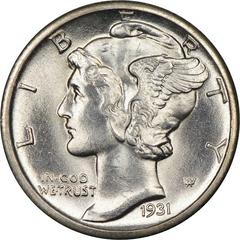
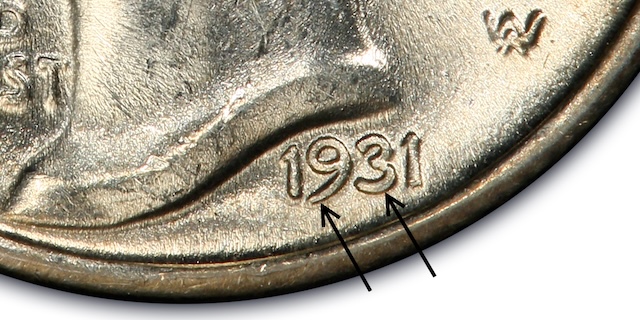
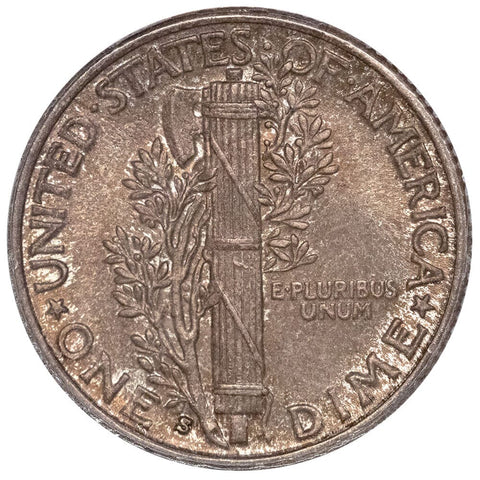
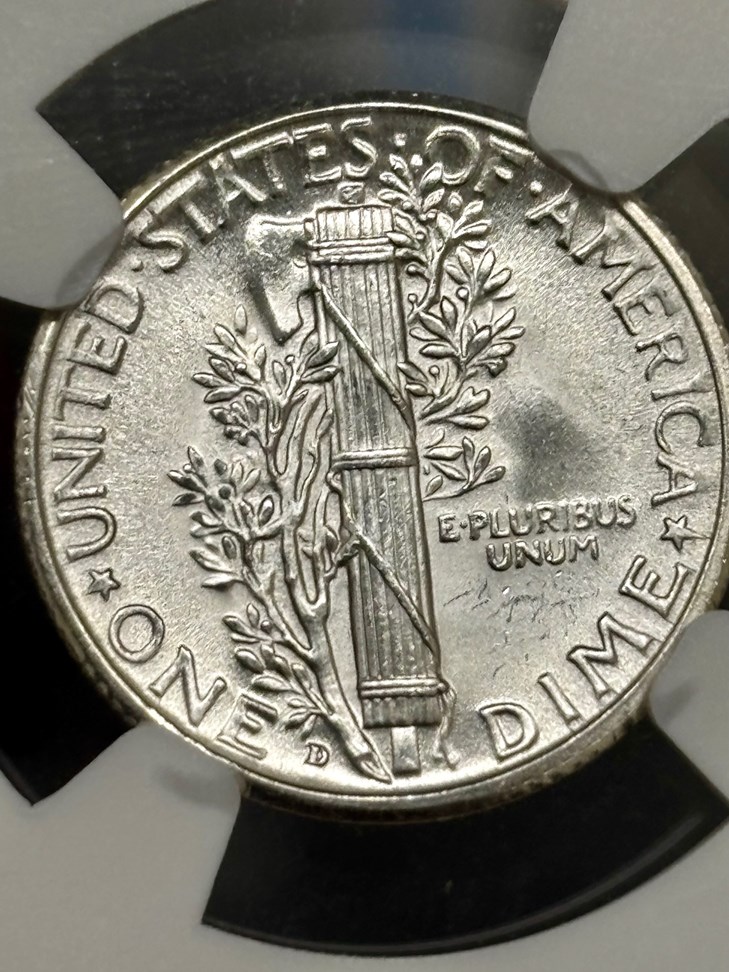
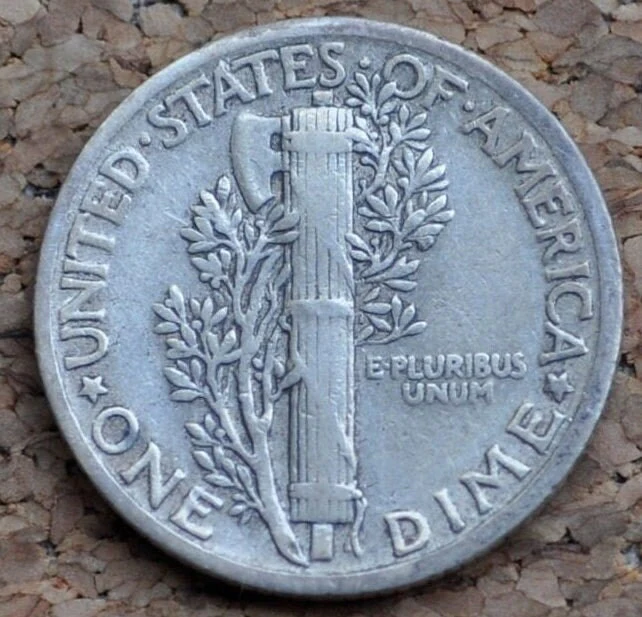
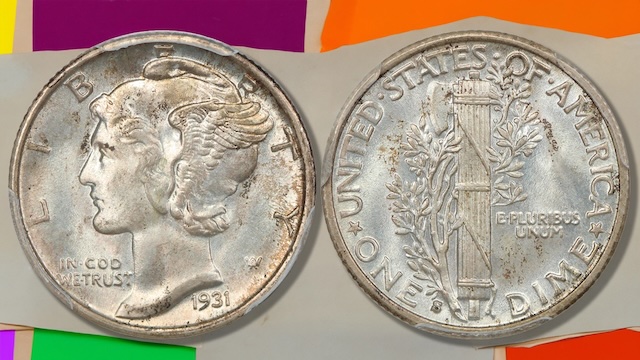
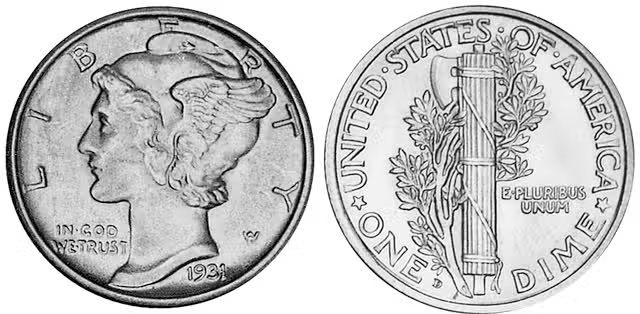
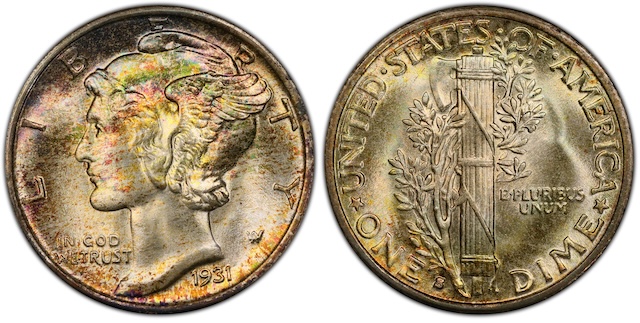
1931 Mercury dime obverse and reverse showing Liberty winged cap and fasces design

Free 1931 Dime Value Calculator & Complete Guide

A single 1931-S Mercury dime graded MS67+FB sold for $270,250 at auction in June 2019 — yet circulated examples start below $10. The difference? Mint mark, condition, and the Full Bands designation on the reverse fasces. This free tool pinpoints where your coin falls.

★★★★★ 4.8 / 5 from 1,347 collectors
Check My 1931 Dime Value →
$270,250
Record auction sale (1931-S MS67+FB, 2019)
6.21M
Total 1931 Mercury dimes minted across all three mints
1.26M
1931-D mintage — lowest of the year, a semi-key date
90%
Silver content — every worn coin has real melt value

Free 1931 Mercury Dime Value Calculator

Select your coin's mint mark, condition, and any recognized varieties below to get an estimated value range based on current market data.

Step 1 — Mint Mark
Step 2 — Condition
Step 3 — Varieties & Errors (check all that apply)

If you're not yet sure about your coin's mint mark or condition, there's a free 1931 Mercury Dime Coin Value Checker tool that lets you upload a photo and get an instant estimate without identifying anything first.

Describe Your 1931 Dime for a Detailed Assessment

Tell us what you see on your coin and our analyzer will flag key value factors — no specialized knowledge required.

Mention these things if you can

  • Any letter to the left of the fasces (D or S, or none)
  • Whether it looks shiny and untouched or worn flat
  • Whether the bands on the reverse look separated
  • Any doubling you notice on the lettering

Also helpful

  • Signs of cleaning or polishing
  • Any unusual toning or discoloration
  • Whether the date and mint mark are sharp or worn
  • Where or how you found the coin
Skipped the calculator?

Get an instant value estimate — just pick your mint mark, condition, and any known varieties.

Use the Free Calculator →

Full Bands Self-Checker: Does Your 1931 Dime Qualify?

The Full Bands (FB) designation is the single biggest value driver on a 1931 dime — it can multiply worth by 5× to 10× in high mint-state grades. Use this checklist to see if your coin might qualify.

Mercury dime reverse comparison showing bands without Full Bands designation versus coin with complete Full Bands separation

Common — No Full Bands

The two central horizontal bands on the fasces are bridged, blended, or only faintly separated. Even under magnification you can see connections between them. This is the typical strike quality for most 1931 dimes, especially Philadelphia and many Denver issues.

— vs —

Valuable — Full Bands (FB)

Both central horizontal bands show a clean, uninterrupted gap all the way across their width. Under a 10× loupe you can see light passing through between them with no bridges or touching points. This sharp strike, particularly prized on the 1931-S, commands dramatic premiums at MS grades.

Check all four that apply to your coin:

  • The two central horizontal bands on the reverse fasces are visibly separated — no touching points or bridges
  • The separation is visible across the full width of both bands, not just at one edge
  • The coin shows no signs of cleaning, polishing, or artificial enhancement of the surface
  • The coin has full original luster — either bright or naturally toned, with no dull, flat areas from circulation

1931 Mercury Dime Value Chart at a Glance

This chart covers all major 1931 Mercury dime varieties across four condition grades. For a deeper look at each variety's identification markers and current PCGS auction data, see the in-depth 1931 dime identification walkthrough and reference guide. The 1931-S FB row (highlighted gold) represents the signature variety with the most dramatic upside.

Variety Worn (G–VG) Circulated (F–AU) Uncirculated (MS60–64) Gem MS (MS65+)
1931-P (No Mint Mark) $7 – $9 $11 – $50 $59 – $1,700 $1,700+
1931-P Full Bands $44 – $71 $92 – $3,450 $3,450+
1931-D (Denver) $11 – $14 $18 – $92 $110 – $1,470 $1,800+
1931-D Full Bands $67 – $100 $140 – $2,300 $5,880 (record)
1931-S Full Bands ★ $15 – $18 $110 – $180 $230 – $3,680 $23,000+ / Record $270,250
1931-S (No FB) $8 – $9 $11 – $100 $130 – $3,680 $3,680+

★ Signature variety. Values are market ranges based on PCGS/Greysheet data; individual coin prices vary by strike quality, toning, and eye appeal.

📱 CoinHix lets you photograph your 1931 dime and cross-reference its condition against graded examples in seconds — a coin identifier and value app.

The Valuable 1931 Mercury Dime Errors (Complete Guide)

Beyond the three standard mint varieties, the 1931 date produced two recognized Doubled Die Obverse (DDO) varieties — one from Denver and one from San Francisco — both catalogued as FS-101 in major variety references. These are the only currently attributed mint errors for the 1931 date, but they reward careful inspection with meaningful premiums. The cards below cover each variety's diagnostic features, recognition tips, and current market context.

1931-D Mercury dime DDO FS-101 obverse showing doubling on IN GOD WE TRUST lettering
Most Valuable $50 – $2,640+

1931-D Doubled Die Obverse — FS-101

The 1931-D DDO FS-101 is a working-die variety caused by a misaligned second hub impression during die manufacture. Because the die received its design elements twice in slightly different positions, every coin struck from that die carries a permanent doubled image on the obverse. The doubling is most concentrated on the obverse inscriptions and was not caught at the Denver Mint before the die entered service.

To recognize this variety, examine "IN GOD WE TRUST" under a 10× loupe. The doubling appears as a distinct secondary set of letters offset from the primary — not a blurred or ghost image caused by die wear, but a sharply defined second impression. The date digits and the word LIBERTY may also show splitting, particularly on the inner curves of the numerals where two edges become visible.

Collector premiums for the 1931-D DDO are substantial precisely because the Denver issue already carries a low-mintage story. Many examples of this variety have circulated through collections unattributed, keeping the attributed population relatively small. An MS67+ specimen realized $2,640 at auction — well above a standard 1931-D at the same grade — and even circulated pieces in the $50–$150 range command a lift over non-DDO Denver examples.

How to spot it

With a 10× loupe, look at "IN GOD WE TRUST" on the obverse. A clear secondary image — not blur or damage — offset from the primary lettering across the inscription confirms attribution. The date numerals may also show doubled inner edges.

Mint mark

D (Denver) only — small D to the left of the fasces base on the reverse. Denver struck 1,260,000 dimes in 1931, the year's lowest regular-issue mintage.

Notable

Catalogued as PCGS #145418 and FS-101 by CONECA. An MS67+ example reached $2,640 at auction. Many examples remain unattributed — a specialist with Greysheet attribution tools can add meaningful value to a raw coin.

1931-S Mercury dime DDO FS-101 obverse showing Doubled Die doubling on obverse inscriptions
Rarest Attributed $40 – $3,425+

1931-S Doubled Die Obverse — FS-101

The 1931-S DDO FS-101 is the San Francisco counterpart to the Denver DDO, sharing the same mechanism — a hubbing misalignment during working-die production — but originating from a separate die pair at the San Francisco Mint. The San Francisco Mint in 1931 was also notable for producing some of the sharpest strikes in the series, which creates an interesting interplay: the best-struck 1931-S coins can carry both the DDO attribution and a Full Bands designation simultaneously.

The doubling on this variety follows the same obverse-inscription pattern as the Denver DDO. Under a 10× loupe, "IN GOD WE TRUST" shows a secondary letter set clearly offset from the primary. The innermost strokes of the date digits are also a diagnostic area, with the first 1, the tail of the 9, and the base of the 3 each displaying a visible secondary edge under proper lighting. The doubling is subtle enough that most circulated examples have never been formally attributed.

The premium spread on the 1931-S DDO is particularly dramatic when Full Bands is also present. A non-FB MS63 sold for $228, while an MS65FB example with the DDO attribution reached $3,425 — a gap that illustrates how two premium factors compound each other. The FS-101 designation is the key attribution, and collectors pursuing registry sets actively seek these coins.

How to spot it

Inspect "IN GOD WE TRUST" on the obverse with a 10× loupe under raking light. A secondary letter outline clearly offset from each primary letter — distinct from die polish or wear distortion — confirms the FS-101 variety. Check the inner curves of the date digits as a secondary confirmation point.

Mint mark

S (San Francisco) only — small S to the left of the fasces base on the reverse. San Francisco struck 1,800,000 dimes in 1931.

Notable

Catalogued as PCGS #145443 (non-FB) and #145444 (FB). An MS65FB example sold for $3,425 at auction; an MS63 non-FB piece brought $228. The gap between FB and non-FB specimens here is among the widest in the 1931 series.

1931-S Mercury dime reverse fasces close-up showing Full Bands separation between central horizontal bands
Record Holder $230 – $270,250

1931-S Full Bands — The $270,250 Specimen

The 1931-S Full Bands is not a mint error in the traditional sense — it is a strike quality designation that recognizes the San Francisco Mint's superior die preparation and hub pressure in 1931. The result is a coin on which both central horizontal bands of the reverse fasces are fully separated, producing a surface detail sharp enough to drive the most dramatic premium in the entire 1931 Mercury dime series. At its peak, a single MS67+FB example sold for $270,250.

Full Bands on the 1931-S are recognized by PCGS and NGC when both central horizontal bands show complete, uninterrupted separation across their full width. The bands must not touch, bridge, or blend at any point — even a hairline connection disqualifies the designation. Because the San Francisco Mint consistently produced sharper hub impressions than Denver or Philadelphia in this era, the 1931-S has a higher natural rate of FB survivors, but gem-quality examples remain genuinely scarce.

The price structure for the 1931-S FB is steep and condition-sensitive. MS64FB examples trade around $500–$1,500; MS65FB specimens reach $3,000–$5,000 or more; and anything grading MS66FB or above enters rare-coin territory. The record $270,250 paid for an MS67+FB example at Legend Rare Coin Auctions in June 2019 stands as the benchmark for the entire 1931 date across all mints.
How to spot it

Using a 10× loupe, inspect the two central horizontal bands on the fasces reverse. Full separation — light visibly passing between both bands across the entire width with no bridges — means FB qualification. Even a hairline connection anywhere disqualifies the coin.

Mint mark

S (San Francisco) only. The S appears to the left of the fasces base on the reverse. The San Francisco Mint struck 1,800,000 dimes in 1931.

Notable

PCGS #4987. An MS67+FB example realized $270,250 at Legend Rare Coin Auctions, June 2019 — the highest price ever recorded for any 1931 dime. Greysheet prices for 1931-S FB range from $285 to $17,000+ depending on grade.

1931-D Mercury dime showing D mint mark on reverse and Liberty winged cap obverse in circulated condition
Semi-Key Date $11 – $5,880

1931-D Mercury Dime — Lowest Mintage of the Year

The 1931-D Mercury dime was struck at Denver with a mintage of just 1,260,000 — the lowest of any regular-issue Mercury dime in 1931 and one of the lower annual totals for the entire series. This scarcity earns it semi-key status among Mercury dime collectors, meaning it is neither as rare as the great key dates of the series nor as easy to find as the common Philadelphia issues. At any grade above Fine, the 1931-D commands a meaningful premium over its Philadelphia counterpart.

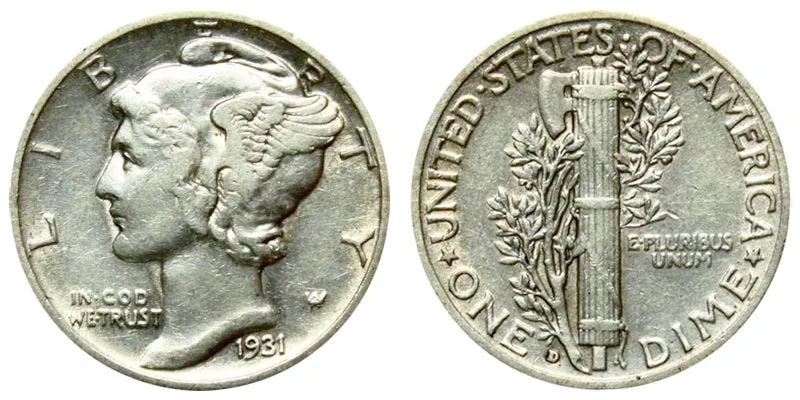
Identifying the 1931-D requires flipping the coin to the reverse and looking for a small "D" mintmark to the left of the lower section of the fasces bundle. The mint mark is small and can be partially obscured by strike weakness or wear in lower grades. Under a 5× loupe the "D" should be legible in all but the most heavily worn pieces. The obverse features are identical to all other 1931 Mercury dimes — Liberty's winged cap portrait designed by Adolph Alexander Weinman.

The market for the 1931-D responds sharply to condition upgrades. A Good-grade piece sells in the $11–$14 range; an MS67 non-FB example brought $1,800 at Stack's Bowers in November 2019. When Full Bands are added, the ceiling rises further: the FB auction record for the 1931-D stands at $5,880 for an MS67FB example, confirming that sharp strikes from Denver carry substantial collector premiums.

How to spot it

On the reverse, look to the left of the lower fasces bundle for a small "D" mintmark. Under a 5× loupe it should be clearly legible. The mint mark is the only visual distinction from the Philadelphia issue — all obverse details are identical.

Mint mark

D (Denver) only. Denver struck 1,260,000 Mercury dimes in 1931 — the year's lowest regular-issue total and a significant driver of collector demand.

Notable

PCGS #4984. An MS67 non-FB example brought $1,800 at Stack's Bowers (November 2019); the MS67FB record stands at $5,880. The 1931-D DDO FS-101 sub-variety adds a further premium layer for attributed specimens.

1931 Philadelphia Mercury dime no mint mark obverse and reverse showing typical circulated condition
Most Common $7 – $3,450+

1931-P (No Mint Mark) — Philadelphia's Most Accessible Entry

The 1931 Philadelphia Mercury dime carries no mint mark and represents the most frequently encountered of the three 1931 varieties, with 3,150,000 struck. For a Mercury dime, however, even the "common" 1931-P is relatively scarce compared to later-decade issues — 1931 falls in the trough of Depression-era coin production, when all three mints dramatically reduced output compared to the boom years of the mid-1920s. This means even worn Philadelphia examples are worth multiples of face value as silver bullion alone.

Confirming a Philadelphia origin is simple: check the reverse to the left of the fasces base. The absence of any mint mark letter confirms Philadelphia manufacture. The obverse is identical in design to Denver and San Francisco issues. In circulated grades the Philadelphia dime is visually indistinguishable from its sister issues except by that mint mark location check.

In heavily worn Good condition, the 1931-P trades in the $7–$9 range. Circulated Fine to AU examples span $11–$50. Uncirculated pieces without Full Bands run $59–$1,700, and Full Bands specimens jump to $92–$3,450. The PCGS auction record for the 1931-P Full Bands is $17,400 for an MS67+FB example sold at Heritage Auctions in January 2024, a result that underscores how even the "common" Philadelphia issue can reach impressive heights in the highest grades.

How to spot it

Check the reverse left of the fasces base — no letter present confirms Philadelphia. Under a 5× loupe the area should be blank field. If any "D" or "S" is present, the coin is a Denver or San Francisco issue worth reassessing.

Mint mark

None — Philadelphia Mint struck 3,150,000 Mercury dimes in 1931. Philadelphia issues carry no mint mark on any Mercury dime of the series.

Notable

PCGS #4982 (non-FB) and #4983 (FB). The FB auction record is $17,400 for an MS67+FB at Heritage Auctions, January 2024. Full Bands are available on Philadelphia dimes but remain scarce in gem grades.

Found one of these varieties on your coin?

Run the calculator now to get an estimated value range based on your specific mint mark, grade, and variety combination.

Calculate My Coin's Value →

1931 Mercury Dime Mintage & Survival Data

Group of 1931 Mercury dimes showing Philadelphia, Denver, and San Francisco mint mark examples side by side
Mint Mint Mark 1931 Mintage Notable Survival
Philadelphia None 3,150,000 Most common 1931 issue; FB examples scarce in gem grades
Denver D 1,260,000 Lowest mintage of the year; semi-key status; DDO FS-101 variety recognized
San Francisco S 1,800,000 Sharpest strikes; highest FB survival rate; record $270,250 for MS67+FB
Total (All Mints) 6,210,000 Depression-era low output; all three varieties scarce relative to earlier years
Composition & Specs: 90% silver, 10% copper · Weight: 2.50 g · Diameter: 17.9 mm · Edge: Reeded · Designer: Adolph Alexander Weinman (AAW) · Series: Mercury Dimes, 1916–1945. At current silver prices, even heavily worn 1931 dimes have meaningful intrinsic metal value above $2 in melt.

How to Grade Your 1931 Mercury Dime

Mercury dimes grade primarily on the obverse hair detail and reverse band clarity. The 17.9 mm silver coin shows wear quickly at the high points — Liberty's hair waves above the forehead, the leading wing edge, and the fasces bands on the reverse.

1931 Mercury dime grading strip showing four examples from Good through Mint State condition

Worn (G–VG)

Liberty's hair above the ear shows little to no strand separation. Wing detail is flat. On the reverse, the rods of the fasces blend together and horizontal bands are invisible. The date and "LIBERTY" are readable. Worth $7–$14 depending on mint mark.

Circulated (F–AU)

At Fine, major hair strands separate but high curls are flat. Bands on the reverse are outlined but not split. About Uncirculated shows only slight friction on the hair waves and band ridges, with most luster intact. Worth $11–$100+ by mint mark.

Uncirculated (MS60–64)

No wear anywhere; full mint luster present. Contact marks and bag marks are visible to the naked eye. The fasces bands may be flat or separated depending on strike quality. Full Bands qualification starts here and can triple or quadruple value.

Gem MS (MS65+)

Exceptional luster, very few contact marks, strong eye appeal. At MS65, marks are light and require slight magnification. MS66 and above are nearly pristine. Full Bands gems are the most desirable — record prices for the 1931-S FB reach into the hundreds of thousands.

Pro Tip — Color Designation: Mercury dimes struck in 90% silver can develop attractive toning over decades. Natural toning in steel-blue or golden-amber hues is generally welcome to collectors and does not hurt grade. Artificial toning or cleaning, however, results in a "details" grade from PCGS and NGC, sharply cutting value. Always store in inert holders and never clean.

🔎 CoinHix lets you match your coin's surface against graded reference examples to verify condition before you submit for professional grading — a coin identifier and value app.

Where to Sell Your 1931 Mercury Dime

The right venue depends on your coin's grade and whether it's attributed. A worn $10 coin and a gem Full Bands example need very different selling strategies.

🏆 Heritage Auctions

Best for gem uncirculated or Full Bands specimens — particularly if PCGS or NGC graded. Heritage's numismatic auction house reaches the deepest pool of serious Mercury dime collectors and has achieved the top auction results for the series. Fees apply; best for coins worth $500+.

📦 eBay

Strong market for circulated to mid-range uncirculated examples. Check recently sold prices for 1931 Mercury dimes on completed eBay listings to set a realistic "Buy It Now" price or opening bid. Graded slabs sell faster and at higher prices than raw coins on the platform.

🏪 Local Coin Shop

Fast, no-hassle cash for circulated examples. Dealers typically pay 60–75% of retail for worn pieces and closer to 80–85% for sought-after mint-state examples they can resell quickly. Shop around — offers can vary significantly between dealers for a semi-key date like the 1931-D.

💬 Reddit r/Coins4Sale

Good for mid-grade collectors. The subreddit reaches a knowledgeable audience willing to pay fair retail for attributed varieties and nicely original examples. Requires clear, well-lit photos and honest descriptions. No seller fees, but payment is typically via PayPal or Venmo.

💡 Get It Graded First: If your 1931-S or 1931-D appears uncirculated with what looks like Full Bands separation, a PCGS or NGC submission is almost always worth the fee. A raw MS65 coin may sell for $200–$300; the same coin certified MS65FB by PCGS could realistically command $3,000–$5,000. For gem examples, professional certification pays for itself many times over.

Frequently Asked Questions — 1931 Dime Value

How much is a 1931 dime worth?
A 1931 Mercury dime's value depends heavily on mint mark, grade, and whether it has Full Bands. Worn Philadelphia examples start around $7–$8. Uncirculated 1931-P pieces run $59–$1,700, while an uncirculated 1931-S with Full Bands can reach $230–$23,000+. The overall series record is $270,250 for a 1931-S MS67+FB sold in June 2019.
What is the rarest 1931 dime?
The 1931-D is the scarcest regular-issue 1931 dime by original mintage, with only 1,260,000 struck at Denver. However, the most valuable individual specimen comes from San Francisco: a 1931-S MS67+FB example sold for $270,250 in 2019. In terms of specialized varieties, the 1931-D DDO FS-101 and 1931-S DDO FS-101 are the rarest attributed varieties.
What is Full Bands (FB) on a 1931 Mercury dime?
Full Bands refers to the central horizontal bands on the fasces shown on the reverse of a Mercury dime being completely separated, with no bridges or interruptions between them. This designation, awarded by PCGS and NGC for uncirculated examples, signals a sharply struck coin and commands a dramatic premium — sometimes 10× or more over a non-FB example at the same numeric grade.
What does the 1931-S Mercury dime sell for?
Worn 1931-S dimes start around $8–$9 in Good condition and reach $11–$12 in Fine. Uncirculated examples without Full Bands range from $130 to $3,680, while Full Bands examples jump dramatically — from $230 in lower MS grades to over $23,000 at MS65FB and the record $270,250 at MS67+FB (Legend Rare Coin Auctions, June 2019).
What is the 1931-D Mercury dime worth?
The 1931-D dime, struck at Denver with only 1,260,000 produced, is the lowest-mintage regular issue of 1931. In Good condition it fetches around $11; Fine examples sell for $18–$23. Uncirculated 1931-D dimes range from $110 to $1,470, and Full Bands specimens go from $140 to $2,300. The auction record for the 1931-D FB is $5,880 for an MS67FB example.
Is there a 1931 dime error coin?
Yes. Two Doubled Die Obverse (DDO) varieties are recognized for the 1931 date: the 1931-D DDO FS-101 and the 1931-S DDO FS-101. Both show doubling primarily on the obverse lettering — most noticeably on "IN GOD WE TRUST." The 1931-D DDO has reached $2,640 at auction, and the 1931-S DDO FB version sold for $3,425 at MS65FB.
How do I tell if my 1931 dime has Full Bands?
Examine the reverse fasces (the bundle of rods) under a 5× to 10× loupe. Focus on the two central horizontal bands that bisect the bundle. If both bands show a clear gap between them — meaning light passes through the separation across the full width with no bridges or blending — the coin qualifies for Full Bands. Any connection between the bands, however small, disqualifies the designation.
What mint marks were used on 1931 dimes?
Three mints produced Mercury dimes in 1931. Philadelphia struck 3,150,000 and used no mint mark — check the reverse left of the fasces base and find nothing there. Denver struck 1,260,000 and placed a small "D" in that position. San Francisco struck 1,800,000 and placed a small "S." The mint mark is on the reverse, not the obverse, which surprises many new collectors.
What is the composition of a 1931 Mercury dime?
The 1931 Mercury dime is composed of 90% silver and 10% copper, exactly like all Mercury dimes produced from 1916 through 1945. It weighs 2.50 grams, measures 17.9 mm in diameter, and has a reeded edge. The designer was Adolph Alexander Weinman. At current silver prices, even heavily worn examples carry meaningful melt value.
Should I clean my 1931 dime before selling it?
Never clean a 1931 Mercury dime. Cleaning permanently destroys the original mint luster and surface texture that grading services evaluate. A cleaned coin receives a "details" grade from PCGS or NGC, which reduces its market value by 50–90% compared to an original-surface example at the same numeric grade. Even light polishing or wiping can cause this damage. Leave the coin exactly as you found it.

Ready to find out what your coin's worth?

Use the free calculator — select your mint mark, condition, and any varieties in under 60 seconds.

Calculate My 1931 Dime Value →